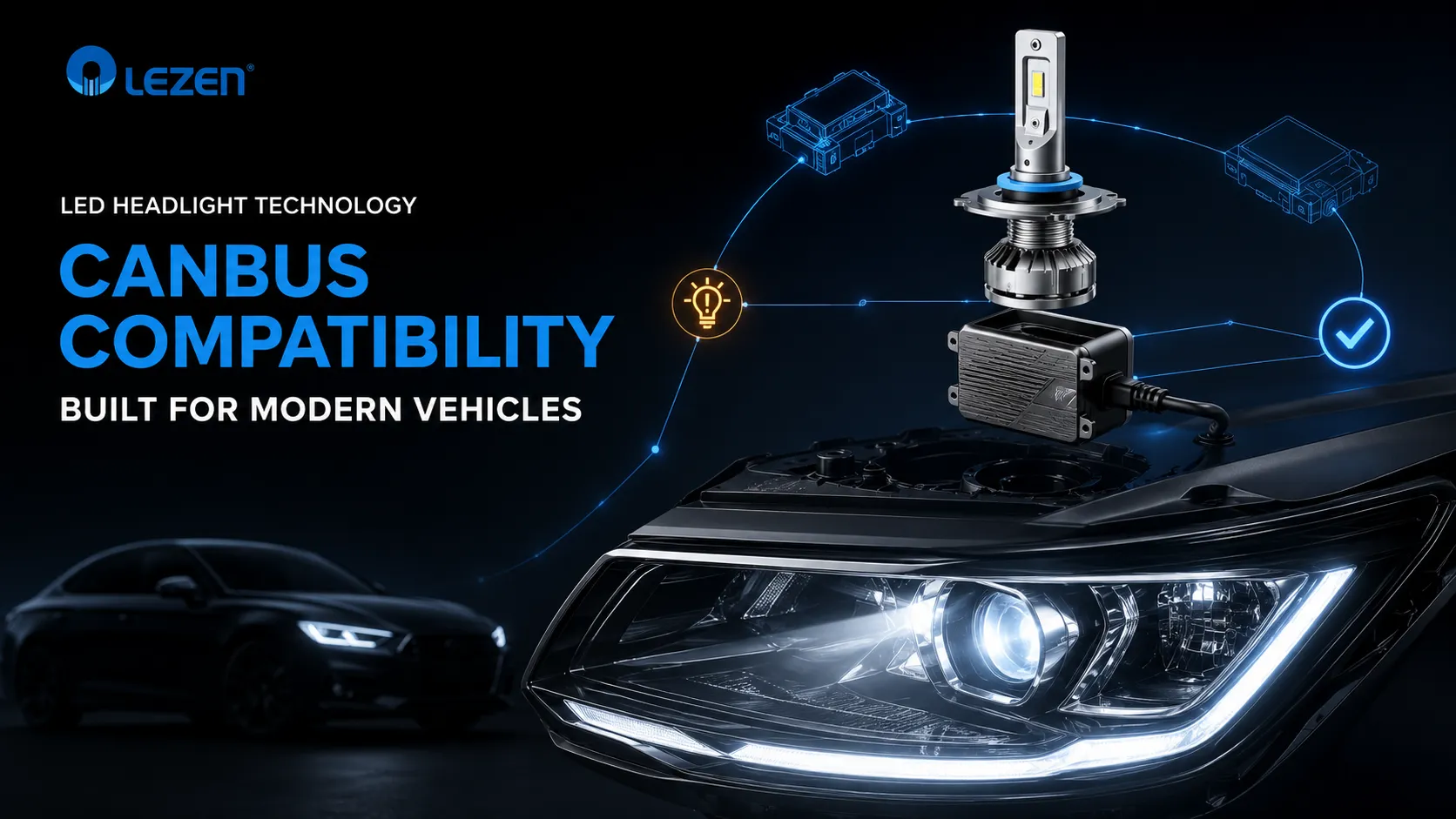
CANBUS compatibility helps LED headlights work correctly with the monitoring systems used in many modern vehicles.
Upgrading a halogen headlight to LED may look simple: remove the original bulb, install the LED replacement and turn on the light. In many vehicles, that is all it takes. In others, the new bulb lights up but immediately creates a dashboard warning, flickers during startup or switches off after a few seconds.
The difference is often not the LED chip or bulb socket. It is the way the vehicle monitors and controls its lighting circuit.
For automotive lighting importers, distributors and private-label brands, CANBUS compatibility is therefore more than a technical feature on a product box. It can affect customer satisfaction, installation success, warranty costs and the reputation of an entire product line.
This guide explains what CANBUS compatibility really means, why different vehicles respond differently to the same LED bulb and how wholesale buyers can evaluate a solution before placing a bulk order.
What Is CANBUS in a Modern Vehicle?
What Is CANBUS in a Modern Vehicle?
CANBUS (Controller Area Network Bus) is a robust communication system in modern vehicles that allows various electronic control units (ECUs), such as engine, transmission, and braking systems, to communicate efficiently without needing complex wiring. It ensures seamless data sharing for enhanced performance, diagnostics, and automation.
How CANBUS Works
CANBUS operates as a two-wire communication protocol where ECUs exchange data through a digital network. The system uses two main data lines: CAN High and CAN Low. These lines carry voltage signals to represent binary data, enabling devices to send or receive messages. The protocol is designed to prioritize messages based on importance, ensuring real-time responses for critical functions like safety systems.
For more details on how CANBUS works, you can refer to this Wikipedia article on CAN bus.
Key Applications of CANBUS in Vehicles
- Engine Management: Facilitates communication between sensors and the Engine Control Unit (ECU) for optimized fuel efficiency and performance. Learn more about Engine Control Units.
- Braking Systems: Enables integration of ABS (Anti-lock Braking System) and traction control by sharing wheel speed data across modules.
- Infotainment: Supports multimedia systems, navigation, and voice commands through seamless communication between head units and other components.
- Diagnostics: Helps mechanics retrieve fault codes and monitor system performance during maintenance. For an overview of vehicle diagnostics, check out this On-Board Diagnostics (OBD) guide.
Pros and Cons of CANBUS
| Pros | Cons |
|---|---|
| Reduces wiring complexity | Vulnerable to cyberattacks |
| Enables real-time communication | Requires specialized diagnostic tools |
| Improves vehicle efficiency | Can be expensive to repair |
| Facilitates modular upgrades | Limited data bandwidth for high-demand applications |
Conclusion & Expert Tip
CANBUS is the backbone of electronic communication in modern vehicles, enabling smarter, safer, and more efficient automotive systems.
LEZEN Lighting Pro Tip: “We found that upgrading vehicle lighting with CANBUS-compatible LEDs prevents flickering and error messages on modern dashboards. Always ensure compatibility to maintain system integrity.”
Why Do Modern Vehicles Monitor Headlight Bulbs?
Modern vehicles monitor headlight bulbs to ensure optimal visibility, safety, and energy efficiency. By detecting bulb failures or malfunctions, these systems alert drivers promptly, reducing risks during nighttime driving and adverse weather conditions. This feature relies on advanced sensors and diagnostic systems integrated into the vehicle’s electrical network.
How Headlight Monitoring Systems Work
Modern headlight monitoring systems operate by continuously measuring the electrical resistance or current flow associated with each bulb. When a bulb fails, the system detects abnormal readings and triggers a warning on the dashboard. This process involves key components such as sensors, the vehicle’s control unit, and alert mechanisms.
Key Steps in the Monitoring Process:
- Electrical Current Measurement: Sensors detect changes in power consumption or resistance levels.
- Data Analysis: The control unit compares readings against pre-set thresholds to identify abnormalities.
- Driver Alert: If a fault is detected, the system activates a warning light or message on the dashboard, indicating which bulb needs attention.
Benefits of Monitoring Headlight Bulbs
Advantages for Drivers:
- Improved Safety: Ensures consistent road visibility by promptly notifying drivers of bulb failures.
- Convenience: Reduces the need for manual inspections, saving time and effort.
- Energy Efficiency: Helps maintain optimal performance by identifying issues that could lead to energy waste.
Advantages for Manufacturers:
- Enhanced Reliability: Builds trust by integrating advanced safety features.
- Reduced Liability: Encourages drivers to promptly resolve bulb issues, minimizing accident risks.
Common Challenges with Headlight Monitoring Systems
While beneficial, these systems are not without challenges. Below are some potential drawbacks:
| Challenge | Description |
|---|---|
| False Alerts | Sensor errors may occasionally trigger warnings for functioning bulbs. |
| Compatibility Issues | Aftermarket bulbs or LED upgrades may not work seamlessly with monitoring systems. |
| Repair Complexity | Diagnosing and fixing monitoring system faults often requires specialized equipment. |
Conclusion & Expert Tip
Modern vehicles monitor headlight bulbs to enhance safety, convenience, and reliability, though drivers should remain aware of potential system limitations.
LEZEN Lighting Pro Tip: “We found that using OEM-approved bulbs can prevent compatibility issues with headlight monitoring systems. Always check your vehicle’s specifications before upgrading to aftermarket lighting.”
Common Problems Caused by Poor CANBUS Compatibility
Common Problems Caused by Poor CANBUS Compatibility
Poor CANBUS compatibility can cause various issues such as non-functional electronic components, flickering lights, dashboard error messages, and compromised vehicle communication systems. These problems arise when aftermarket devices fail to properly interface with the vehicle’s CANBUS network, leading to operational disruptions and reduced performance.
Understanding CANBUS Compatibility Issues
CANBUS (Controller Area Network Bus) is a communication protocol used in modern vehicles to enable seamless interaction between electronic components. When aftermarket devices, such as LED lights or infotainment systems, are not compatible with the CANBUS system, it can result in errors that affect vehicle functionality and safety.
Common Symptoms of Poor CANBUS Compatibility
- Flickering or non-operational lights: LED lights connected to a non-compatible CANBUS system may flicker or fail to function entirely due to incorrect power regulation.
- Dashboard error warnings: The vehicle may display error codes or warning lights when it detects irregularities in the communication network.
- Device malfunctions: Features like parking sensors, cameras, or infotainment systems may fail to work correctly.
- Interference with onboard diagnostics: Poor compatibility can hinder diagnostic tools from accurately reading vehicle data, complicating repairs.
How to Prevent CANBUS Compatibility Problems
- Choose CANBUS-compatible products: Ensure aftermarket parts are specifically designed for the vehicle’s CANBUS system.
- **Use a CANBUS decoder: This tool helps bridge compatibility gaps between the vehicle and aftermarket components.
- Verify installation procedures: Incorrect installation can exacerbate compatibility issues. Hiring a professional installer is often advisable.
- Test before permanent installation: Always test new devices on the vehicle’s system to identify potential issues early.
Conclusion & Expert Tip
Proper CANBUS compatibility is crucial for maintaining vehicle safety and function when adding aftermarket components.
LEZEN Lighting Pro Tip: “We found that using a reliable CANBUS decoder with high-quality LED lights prevents flickering and error codes. Always verify compatibility with your car model before purchasing aftermarket products.”
Are All Modern Vehicles CANBUS-Sensitive?
No. Some modern vehicles accept an LED replacement without an additional decoder, while some older or specific European platforms can be highly sensitive to changes in the lighting load.
Compatibility can vary according to:
- Vehicle manufacturer and model
- Production year and market version
- Body control module and software version
- Original halogen, HID or LED lighting configuration
- Cold-detection and hot-detection strategy
- PWM control method
- Voltage and load thresholds
- Previous modifications to the vehicle wiring
Two vehicles can use the same H7 socket but react differently to the same LED bulb. Even different model years of one vehicle can use different lighting control modules.
The practical rule for wholesalers is simple:
Socket compatibility does not guarantee electrical compatibility.
A bulb may physically fit the headlight and create a good beam pattern but still require a different driver or decoder for the vehicle’s monitoring system.
Built-In CANBUS Driver or External Decoder?
Built-In CANBUS Driver or External Decoder?
A built-in CANBUS driver integrates directly into the LED or HID bulb, providing onboard compatibility with vehicles’ CANBUS systems to prevent errors. An external decoder is a separate device connected between the bulb and the vehicle to resolve CANBUS issues, offering flexibility for retrofitting and enhanced error correction.
How Built-In CANBUS Drivers Work
Built-in CANBUS drivers are embedded within the lighting unit itself. They communicate directly with the vehicle’s onboard computer system (ECU) to ensure compatibility and prevent dashboard errors such as “bulb out” warnings. These drivers are designed for plug-and-play convenience, making installation simple and seamless in most vehicles.
Key Features of Built-In CANBUS Drivers:
- Compact design with no external components.
- Simplified installation process.
- Ideal for vehicles with mild CANBUS sensitivity.
- Limited capacity to handle extreme error correction needs.
How External Decoders Work
External decoders are standalone units that act as intermediaries between the vehicle’s wiring and the LED or HID bulb. They are particularly effective for vehicles with highly sensitive CANBUS systems, where built-in drivers might not suffice. These decoders typically come in the form of resistors or capacitors to mimic the electrical load of traditional halogen bulbs.
External Decoder Setup:
- Connect the decoder to the vehicle’s wiring harness.
- Plug the lighting unit into the decoder.
- Test the setup for error-free functionality.
Advantages of External Decoders:
- Superior error correction for advanced CANBUS systems.
- Flexibility to retrofit various lighting systems.
- Suitable for vehicles with complex electrical networks.
Built-In CANBUS Driver vs. External Decoder: A Comparison
| Feature | Built-In CANBUS Driver | External Decoder |
|---|---|---|
| Installation | Simple, plug-and-play | Requires additional wiring setup |
| Compatibility | Limited to moderate CANBUS needs | Works with highly sensitive systems |
| Space Requirements | Compact, no external components | Requires mounting space |
| Performance in High-Sensitivity Systems | Moderate error correction | High error correction capability |
Which Option Should You Choose?
The choice between a built-in CANBUS driver and an external decoder depends on your vehicle’s CANBUS sensitivity and the type of lighting upgrade. Built-in drivers are suitable for standard vehicles, while external decoders are better for advanced or luxury models prone to error warnings.
LEZEN Lighting Pro Tip: “We found that external decoders are the best choice for vehicles with complex CANBUS systems or frequent error messages, while built-in drivers are perfect for quick and clean installations in standard setups.”
What Makes a Reliable CANBUS LED Headlight?
A reliable solution is more than a bulb with a resistor or a “CANBUS” label. Several systems must work together.
Stable LED driver design
The driver should regulate current under the voltage conditions found in real vehicles. It should also manage startup behavior and include appropriate overvoltage, undervoltage and overtemperature protection.
Testing a 12V bulb with a stable laboratory power supply is not enough to represent cold starts, alternator voltage changes or diagnostic pulses in a vehicle.
Appropriate load matching
The solution must present an electrical profile that the target vehicle accepts without creating excessive power consumption or heat. Simply adding a high-power resistor may remove a warning, but it can reduce efficiency and introduce a new thermal risk.
PWM and diagnostic-pulse handling
Some vehicles use pulse-width modulation to control lighting output or send cold and hot diagnostic pulses to check the circuit. The driver or decoder should respond without visible flicker, delayed startup or shutdown.
EMI control
Filtering, shielding, circuit layout and driver quality all influence electromagnetic interference. Radio reception should be tested independently because a CANBUS-compatible load does not automatically mean low EMI.
Thermal management
LED chips, drivers and load components all generate heat. A solution that works for several minutes on an open test bench may behave differently after extended operation inside a closed headlamp.
Temperature testing should cover the bulb, driver and external decoder—not only the LED heat sink.
Why “Error-Free” Is Not a Universal Guarantee
Claims such as “100% CANBUS,” “fits all cars” or “completely error-free” are attractive in sales material, but they are difficult to support across the global vehicle market.
Detection thresholds and control strategies vary between brands, platforms, model years and software versions. A product may work without warnings in most tested vehicles but still require an external decoder for a specific model.
A more reliable definition of error-free performance should include:
- A clearly identified test vehicle
- Model year and market version
- Original headlight configuration
- Bulb socket and beam function
- Test conditions and duration
- Whether an additional decoder was used
For wholesale buyers, “error-free” should be supported by a defined vehicle test list rather than treated as a universal promise.
How Distributors Should Evaluate CANBUS LED Bulbs
Distributors should evaluate CANBUS LED bulbs by assessing compatibility with vehicle systems, lumen output, color temperature, ease of installation, energy efficiency, durability, and compliance with automotive standards. Testing for error-free performance with CANBUS systems and analyzing customer demand trends are also critical for informed purchasing decisions.
Understanding CANBUS LED Bulbs and Their Key Features
CANBUS (Controller Area Network Bus) LED bulbs are designed to communicate with a vehicle’s computer system to avoid dashboard error codes. These bulbs are particularly important for modern vehicles with advanced electronic systems. Below are the key factors to evaluate:
- Error-Free Operation**: Ensure the bulbs are equipped with built-in resistors or decoders to prevent “bulb out” warnings.
- Brightness and Efficiency**: Look for high lumen output and low power consumption for better visibility and energy savings.
- Color Temperature**: Evaluate options ranging from 3000K (warm white) to 6500K (cool white) based on customer preferences.
- Build Quality**: Check for durable materials, waterproofing (IP67 or higher), and efficient heat dissipation mechanisms.
- Ease of Installation**: Verify whether the bulbs are plug-and-play or require modifications.
Common Issues with CANBUS LED Bulbs and Solutions
Distributors should be aware of the frequent challenges associated with CANBUS LED bulbs:
- Dashboard Error Codes : Some bulbs may still trigger error messages despite being labeled as CANBUS-compatible.
- Solution : Recommend bulbs with advanced decoders or additional load resistors.
- Flickering : Poor compatibility can cause flickering when the vehicle’s computer misinterprets the bulb’s power draw.
- Solution**: Opt for bulbs with constant-current drivers to stabilize output.
- Overheating**: High-powered LEDs may overheat without proper heat dissipation.
- Solution**: Choose products with aluminum housing or integrated cooling fans.
Comparing CANBUS LED Bulbs to Non-CANBUS LED Bulbs
| Feature | CANBUS LED Bulbs | Non-CANBUS LED Bulbs |
| Compatibility | Works with vehicles with advanced electronic systems | May trigger error codes in vehicles with CANBUS systems |
| Error Prevention | Built-in resistors or decoders to prevent warnings | Requires additional resistors for CANBUS vehicles |
| Cost | Typically more expensive | Generally cheaper |
| Installation | Plug-and-play in most cases | May require additional wiring or adapters |
Conclusion & Expert Tip
Evaluating CANBUS LED bulbs involves a balance of technical quality, compatibility, and market demand to ensure customer satisfaction and minimize returns.
LEZEN Lighting Pro Tip: “We found that conducting real-world tests on various vehicle models before bulk purchasing can save distributors significant time and cost by identifying actual compatibility issues upfront.”
Importers and private-label brands should test compatibility as a system, not only check whether a sample can light up.
The Business Cost of Poor Compatibility
The purchase price of an LED bulb is only one part of its real cost.
If compatibility is not validated, a distributor may also pay for:
- Customer returns and replacements
- Additional decoders shipped after the sale
- Repeated installation labor
- Technical-support time
- Repacked or reclassified inventory
- Negative product reviews
- Damage to the private-label brand
A low-cost bulb can become an expensive product after warranty handling and technical support are included. For B2B buyers, stable compatibility often protects more profit than a small reduction in unit price.
How LEZEN Supports CANBUS LED Headlight Projects
LEZEN LIGHTING works with automotive lighting importers, distributors, wholesalers and private-label brands. Instead of assuming that one CANBUS configuration will suit every market, we evaluate the bulb application, target vehicles and expected sales region before recommending a solution.
Our support can include:
- Standard, built-in CANBUS and external decoder options
- 12V and 24V LED headlight solutions
- Sample orders for local vehicle testing
- Driver and decoder configuration based on the target market
- OEM logo, color and packaging support
- Installation guidance and compatibility labeling
- Functional inspection before shipment
LEZEN can test the bulb, driver and decoder configuration before shipment and support local vehicle validation with samples.

For a more accurate recommendation, buyers can provide the bulb type, target country, common vehicle list and any existing warning or flicker video. Our engineering team can then help identify whether the issue is related to load detection, diagnostic pulses, voltage, wiring or driver design.
Explore our CANBUS LED headlight solutions or compare available H4 LED headlight bulbs, H1 LED headlight bulbs,H7 LED headlight bulbs and fan-cooled LED headlight bulbs.
CANBUS Compatibility Checklist for Wholesale Buyers
Before approving a product for bulk purchase, confirm:
- Is the compatibility solution built into the driver or supplied externally?
- Which vehicles and model years have been tested?
- Does it prevent dashboard bulb warnings?
- Has startup and shutdown flicker been tested?
- Can the driver handle PWM-controlled circuits?
- Has radio interference been evaluated separately?
- What is the operating temperature of the driver and decoder?
- Is there enough space inside or behind the headlamp?
- Have 12V and 24V versions been validated separately?
- What solution is available if a specific vehicle still reports an error?
- Can samples be tested before the bulk order?
Frequently Asked Questions
Does every modern vehicle need a CANBUS LED bulb?
No. Some vehicles accept LED replacements without any additional decoder. The requirement depends on the vehicle’s bulb-monitoring and lighting-control system, not only on its age.
Does an H4 LED bulb always need a CANBUS decoder?
No. H4 describes the bulb base and dual-beam function. Whether a decoder is necessary depends on the vehicle’s electrical design. The same principle applies to H1, H7, H11, 9005 and other bulb types.
Can a CANBUS decoder stop LED flickering?
It can help when flickering is caused by diagnostic pulses, PWM control or load mismatch. Flickering can also result from poor connections, grounding, voltage instability or a defective driver, so the cause should be confirmed first.
Does CANBUS compatibility eliminate radio interference?
Not necessarily. Radio interference is mainly an EMI issue. A bulb should be tested for radio noise separately from dashboard warnings and flickering.
Is a built-in CANBUS driver better than an external decoder?
Neither is always better. Built-in solutions are compact and easier to install. External decoders offer more flexibility for sensitive vehicle applications but require extra space and careful heat management.
Can one CANBUS LED bulb work in every vehicle?
No supplier can reliably guarantee every vehicle, model year and lighting configuration with one solution. A tested compatibility list and market-specific sample testing provide more useful evidence than a universal claim.
How should an importer test a CANBUS LED headlight?
Test it in representative vehicles from the destination market. Check dashboard warnings, cold and warm starts, shutdown flicker, high/low beam operation, radio reception and continuous operating temperature before approving mass production.
Compatibility Protects More Than the Headlight
CANBUS compatibility is not simply a label printed on an LED bulb package. It involves the interaction between the vehicle’s monitoring strategy, the LED driver, electrical load, diagnostic pulses, EMI control and thermal design.
For distributors and brand owners, the right compatibility solution reduces returns, protects installation partners and makes the product easier to support after the sale. The best approach is to define the target vehicles, test representative samples and choose the appropriate standard, built-in CANBUS or external decoder configuration before placing a bulk order.
Need a CANBUS LED headlight solution for your market?
Send LEZEN your bulb type, target country, common vehicle list and expected order quantity. We can recommend samples for compatibility testing before bulk production.